

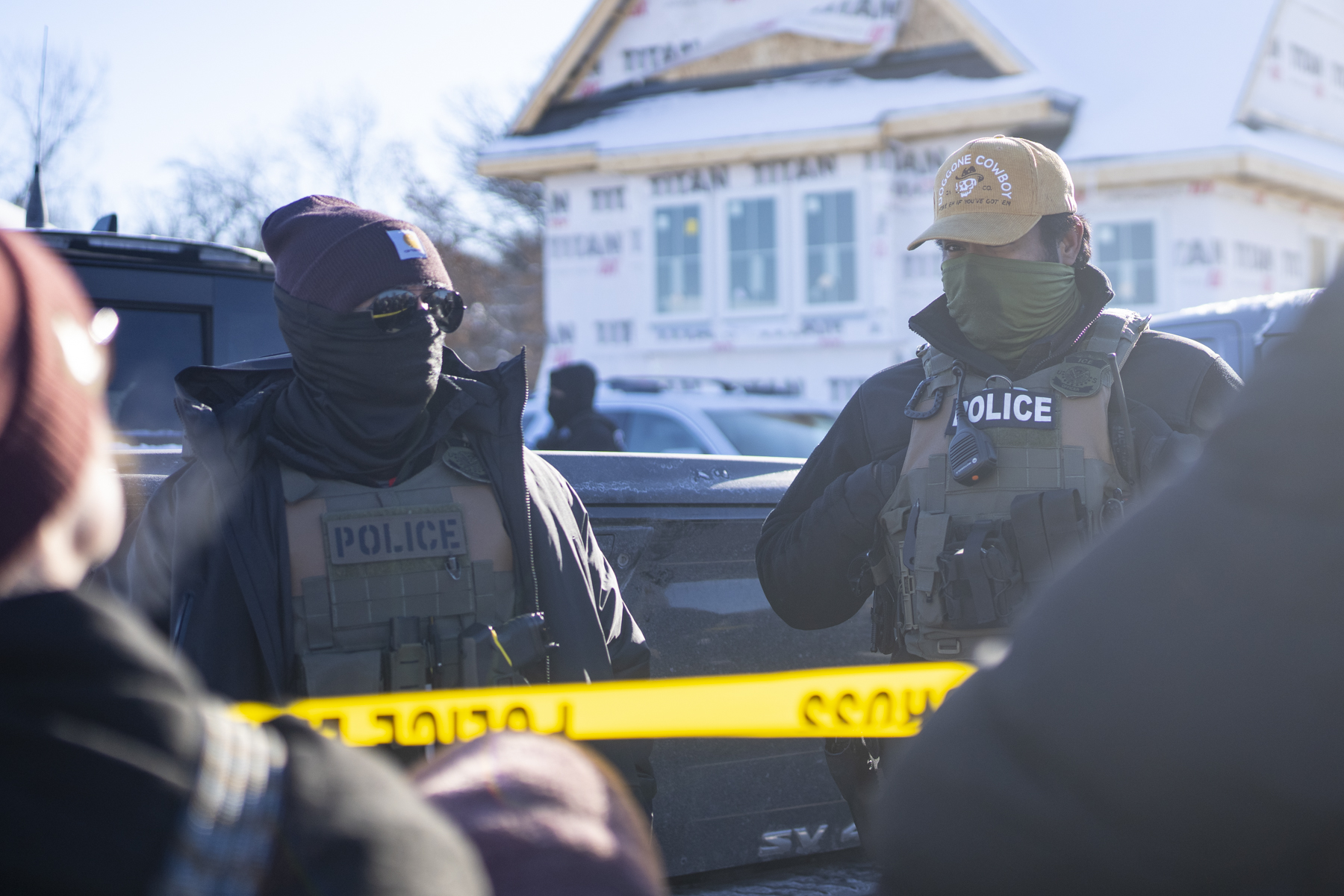
On paper, Operation Metro Surge is over.
It supposedly came to an end on Feb. 12, following border czar Tom Homan’s announcement that federal immigration agents would be withdrawing from Minnesota. There were even indications it might be true.
Observers and elected officials say fewer Immigration and Customs Enforcement (ICE) agents have been seen in the Twin Cities since the announcement. They also have been slower to use chemical agents, leading to fewer high-profile clashes with observers.
In the suburbs, however, they say ICE is using new and increasingly covert tactics to continue operations at levels equivalent to, or in some cases surpassing, Metro Surge.
“As far as Homan’s announcement of a drawdown, there’s no difference,” said Alex Falconer, a Democratic state representative for Minnetonka and Eden Prairie. “In fact, it’s become a little worse.”
ICE expands to the suburbs
In the Twin Cities, officials say ICE activity has reduced since Homan’s announcement, with fewer agents conducting operations using less aggressive tactics. State Sen. Doron Clark said while ICE vehicles are still being observed in his district, which encompasses Cedar Riverside and large parts of North Minneapolis, they are mostly passing through.
“We’ve still seen ICE vehicles around, but they seem to be driving up to Fridley and Columbia Heights,” Clark said. “It seems to be up in the suburbs.”
Observers in these neighborhoods agree, saying that ICE presence in their neighborhoods hasn’t significantly shrunk. Columbia Heights resident Brenna Zeimet said Homan’s announcement brought no immediate relief.
“Right away when he made the announcement, it was still super heavy,” Zeimet said. “We still had convoys, we still had abductions those first couple days.”
Zeimet said that after a relatively quiet weekend, ICE agents were particularly active on Tuesday, staging outside of elementary schools and houses. She also pointed to new tactics seemingly aimed at disguising their operations, including more discrete vehicles.
“They brought a bunch of brand new, gorgeous cars into Whipple, but what we’re actually seeing is like, really old, beat up garbage cars,” she said. “We had a minivan from like 2020 that they don’t even make anymore that was so dirty you couldn’t see the license plate.”
Avonna Starck, a Fridley resident monitoring ICE activity, said similar tactics are being seen in her neighborhood.
“They’re much stealthier,” she said. “They’re not in full military garb. They’re wearing jeans, they’ve got baseball caps on, you really have to look for them now.”
Observers in both neighborhoods say that agents have been operating in smaller groups to avoid drawing attention to themselves. They also said that agents have been using increasingly deceptive tactics, and have more frequently been seen without masks.
Starck, who works for an environmental nonprofit, said her organization has been receiving reports of agents going door-to-door pretending to be environmental canvassers. These tactics have had an impact on her organization’s canvassing group, who are now at risk of being furloughed while ICE operations continue.
“It isn’t safe for the community and it’s not safe for them,” she said.
Other suburbs have been experiencing a similar ICE presence. Mary, an Eden Prairie resident and part of a local community watch group, said there has not been any noticeable decrease in the number of agents in her neighborhood.
“They’re there every single day,” said Mary, who chose not to use her real name for fear of retaliation. “There’s not a day since this announcement we haven’t seen them.”
Mary said that tactics have similarly changed in Eden Prairie. She said that there has been an increase in non-white agents and women driving vehicles while conducting operations, and that agents have been routinely seen staging outside apartments, businesses and in city parks.
She added that agents have also been targeting bus stops, a tactic particularly unnerving for families with children.
“They will sometimes have multiple agents in multiple cars parked at different angles facing the bus stops,” Mary said. “Sometimes one vehicle will sit over the course of two hours watching the same bus stop.”
There are also indications that ICE agents are still staying at local hotels in significant numbers. Christa Sarrack, president of Unite Here Local 17, Minnesota’s hospitality union, said several of the union’s Minneapolis hotels are still housing ICE agents.
“They’re definitely still here,” she said.
Sarrack said that at least three of the union’s hotels are still housing agents, while the agents have left two others. She added that more could be staying at non-union hotels as well, which the union has not been tracking.
In the suburbs surrounding Eden Prairie, Mary said agents have also been visible at hotels. She said her group has identified around 20 ICE vehicles still routinely parked in hotel parking lots.
“They are not in our hotels any less than they were before,” she said. “In fact, we actually saw a few new ones.”
Observers still targeted
Observers and elected officials say that in the aftermath of Homan’s announcement, agents have continued to target observers documenting ICE agents.
According to Erin Maye Quade, a Democratic state senator representing Apple Valley and Rosemount, observers experienced an uptick in aggressive behavior from ICE agents in the days immediately following Homan’s announcement. She said agents followed observers to their homes, drove at them, boxed them in and sat outside their houses.
In Eden Prairie, Mary said agents have done the same.
“We’ve had people almost every day getting followed,” she said.
ICE aggression is not reserved only for community observers. Falconer said ICE agents followed him Tuesday morning part of the way to the State Capitol for the start of the new legislative session.
“I had an ICE vehicle follow me from Eden Prairie all the way close to the Whipple Building, because that’s on my way to the Capitol,” Falconer said. “There was no license plate on the front, and occasionally he would flash his lights.”
Elected officials have also noticed increased drone activity in the suburbs, which they suspect to be ICE. Falconer said drones have become a common sight in Eden Prairie.
“Within the past couple weeks we’ve had drones flying directly over our house, then throughout the neighborhood,” Falconer said. “When I called the city, they didn’t have any drone pilots in operation during that time, and nobody told them about it.”
Democratic state representative Lucy Rehm said there have also been more drones and helicopters over her district of Chanhassen and Chaska since Homan’s announcement last week.
She said that in her district, ICE’s tactics have changed, but the number of agents has not.
“It seems like Operation Metro Surge has morphed into something else, and I’m not sure what that is,” Rehm said.
Too soon to move on
For many, Homan’s announcement was met with optimism that ICE presence in Minnesota might soon be over. That optimism has thus far been unfounded.
“This is still ongoing, and the devastating impacts are going to be generational,” Maye Quade said.
ICE operations in Minnesota have had a crippling financial effect on families and businesses, with many throughout the state struggling to make ends meet. With the new legislative session beginning this week, there’s renewed focus on how to provide relief to those who were affected.
Maye Quade said that while the need to support impacted residents is great, there are still pressing security concerns at hand.
“Now that people are starting to turn their focus towards ‘recovery,’ it’s just like, it’s not even over yet.”
For community observers like Zeimet, it’s not yet time to look ahead to a post-ICE reality. She said that today, neighbors are still afraid, and still prevented from rebuilding their lives.
“The media’s moving on, people are moving on like the story is closing,” Zeimet said. “But people are still unable to leave their homes.”
Correction: Avonna Starck’s name has been updated in this story.
